

The Market’s New Titans & Your Next Move
The stocks featured in this report were previously delivered in our trading room in real-time. To access Stock Region’s real-time trade ideas, then be sure to purchase a membership now.

Disclaimer: The following content is for informational and entertainment purposes only. It should not be considered financial or investment advice. The views and opinions expressed in this newsletter are those of the author and do not necessarily reflect the official policy or position of Stock Region. All investments involve risk, and you should conduct your own research and consult with a qualified financial advisor before making any investment decisions. Ticker symbols and company statistics are provided for context and are subject to market changes.
Table of Contents
Market Pulse: A Holiday Gift of Lower Inflation?
The Netflix Shockwave: A New King is Crowned in Hollywood
The Great AI Arms Race: Google’s Revenge & The Infrastructure Bottleneck
Geopolitical Chess: Trump, Putin, and the Shifting Sands of Global Power
Sector Spotlight: Robotics, EVs, and the Future of Automation
Growth Stocks on Our Radar
Overall Market Forecast: Navigating the Double-Digit Dreams of 2026
1. Market Pulse: A Holiday Gift of Lower Inflation?
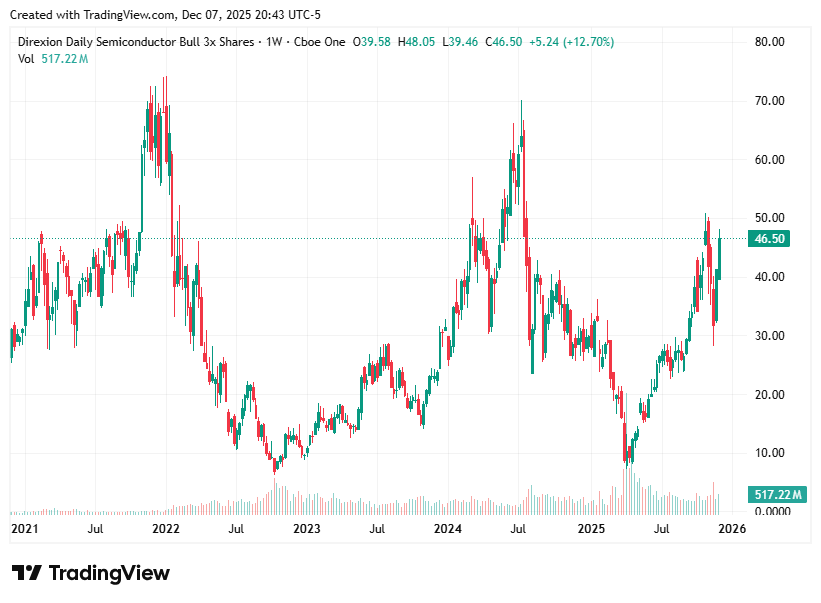
Good morning, Stock Region family. What a whirlwind of a week it’s been. As we barrel towards the holidays, it feels like the market has decided to give us a little gift to unwrap early. Gas prices are finally dipping below $3 a gallon for the first time in what feels like an eternity. Seeing that number at the pump brings a small, but significant, sigh of relief. It’s a tangible sign that some of the inflationary pressures squeezing our wallets might be loosening their grip.
The core inflation rate for September, though delayed, came in at 2.8%. This was lower than many of the big-brained economists on Wall Street were predicting. For months, we’ve been living under the shadow of the Federal Reserve’s next move, with every data point scrutinized for hints of another rate hike. This cooler-than-expected number is a big deal. It might just give the Fed the cover it needs to pause, to breathe, and maybe, just maybe, start thinking about a pivot in the other direction.
I can’t overstate the psychological impact of this. For the average person, lower gas prices mean more money for holiday shopping or paying down debt. For the market, it’s a signal that the economy might just be able to stick the “soft landing” that everyone has been talking about for years. It’s the difference between bracing for a recession and hoping for a recovery.
Now, let’s not get ahead of ourselves. One month of data doesn’t make a trend. But coupled with Wall Street’s increasingly bullish predictions for 2026, there’s a palpable sense of optimism building. The whispers of double-digit gains are getting louder.
However, this optimism is tempered by a healthy dose of reality. The global stage is as complex as ever, and political winds can shift without warning. We’re seeing major moves in geopolitics, huge corporate consolidations, and an AI race that is redefining entire industries. So while we can enjoy the relief of lower inflation, we must remain vigilant. The market is a beast that is never truly tamed. It’s a landscape of opportunity, but also one of potential pitfalls. Today, we’ll dive deep into the seismic shifts that are shaping this new landscape, starting with the deal that has all of Hollywood, and Wall Street, holding its breath.
2. The Netflix Shockwave: A New King is Crowned in Hollywood
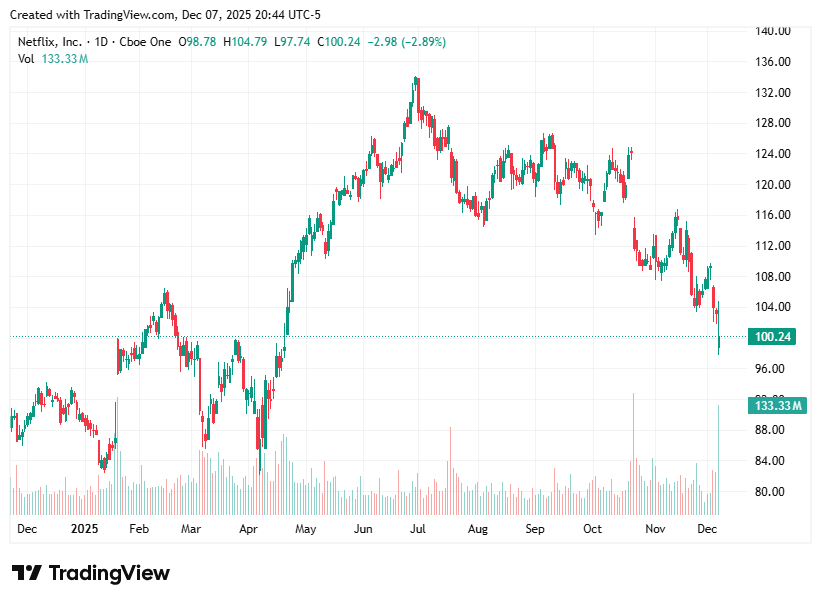
Let’s just pause and absorb this for a moment: Netflix is buying the Warner Bros. film studio and HBO Max.
For decades, Warner Bros. has been a cornerstone of Hollywood, the studio behind The Dark Knight, Harry Potter, and Casablanca. HBO, the crown jewel of television, set the standard for prestige drama with shows like The Sopranos, Game of Thrones, and Succession. And now, they will fall under the banner of the company that started out mailing DVDs in red envelopes.
If you’re a Netflix (NFLX) shareholder, this is a moment of pure vindication. After years of being told their content spending was unsustainable and their model was flawed, they have effectively conquered the very establishment that once looked down on them. Let’s look at the numbers. Netflix, as of its last earnings report, boasted a market cap hovering around $270 billion and a global subscriber base exceeding 280 million. Their revenue for the last twelve months is north of $35 billion, with a healthy profit margin that has been steadily improving. They are a cash-generating machine.
On the other side, you have Warner Bros. Discovery (WBD). The company has been struggling under a mountain of debt since the WarnerMedia-Discovery merger, a figure often cited as being close to $40 billion. While WBD’s revenue is substantial (around $40 billion annually), profitability has been elusive, and the stock has been punished for it. Their market cap has languished, making them a prime target. For WBD, this deal is an act of survival. Spinning off their legacy TV networks like CNN and TNT and selling the studio and streaming assets to Netflix is a drastic, but necessary, move to shed debt and focus on a more manageable business.
What does this mean for the industry? It’s the end of an era and the dawn of a new, consolidated one. Netflix now owns an unparalleled library of intellectual property (IP). Think about it: Batman, Superman, Wonder Woman, the entire DC universe. The wizarding world of Harry Potter. The gritty landscapes of Westeros. All of this now lives in the same house as Stranger Things and Bridgerton. The creative possibilities—and the crossover potential—are staggering. Can you imagine a Batman series with the budget and creative freedom of an HBO original, produced by Netflix? The mind reels.
This deal, set to close in 12 to 18 months, will leave a drastically altered landscape. Disney (DIS) is now Netflix’s sole true global competitor at scale. The pressure on Disney+ and their own stable of IP (Marvel, Star Wars, Pixar) just intensified tenfold. They have a market cap of around $215 billion, a formidable foe, but they are also navigating their own challenges with streaming profitability and the decline of linear television.
Other players like Paramount Global (PARA) and Comcast’s (CMCSA) Peacock suddenly look very, very small. Paramount, with its own rich library including Top Gun and Mission: Impossible, has a market cap of just over $8 billion. Comcast, a behemoth in its own right with a $150 billion market cap, has a streaming service in Peacock that has struggled to gain the same traction. It feels almost inevitable that more consolidation is on the horizon. These smaller studios and streaming services will either have to find a niche to survive or be swallowed up by the remaining titans.
From an investment perspective, the immediate reaction for NFLX is bullish. The market loves a winner, and Netflix just cemented its position at the top of the food chain. The long-term question will be about execution. Integrating a legacy studio like Warner Bros. is a monumental task. There will be culture clashes, redundancies, and strategic pivots. But if CEO Reed Hastings and his team can pull it off, they will have created an entertainment juggernaut the likes of which the world has never seen. For WBD, the future is less certain. A leaner company focused on profitable cable networks could be a stable, dividend-paying stock. But the glamour, and the growth story, will have walked out the door with HBO. This is a story we’ll be watching for years, and its ripples will be felt across every corner of the media world.
3. The Great AI Arms Race: Google’s Revenge & The Infrastructure Bottleneck
For the past couple of years, the narrative in artificial intelligence has been dominated by one name: OpenAI. With the explosive launch of ChatGPT, they captured the world’s imagination and sent every other tech giant scrambling. Microsoft (MSFT) made a brilliant move by backing them, integrating their technology across the entire Microsoft ecosystem and riding the AI wave to a market cap that now flirts with $3.5 trillion. It seemed like Alphabet (GOOGL), the long-reigning king of search and a pioneer in AI research, had been caught flat-footed.
Well, the empire is striking back.
According to Geoffrey Hinton, one of the “godfathers of AI” who himself left Google to warn about the dangers of the technology, Google has now reclaimed the lead. This isn’t small talk. The launch of their Gemini 3 model is producing benchmarks that, in some cases, are slightly outperforming OpenAI’s latest models in crucial areas like knowledge, math, and coding. More importantly, Google is showing its true strength: distribution. Gemini has already been rolled out to 650 million users, rapidly closing the gap on ChatGPT’s 800 million.
This is Google’s superpower. They own the pipes. They are the default entry point to the internet for billions of people through Search, Chrome, and Android. By integrating a superior AI directly into these products, they can shift user behavior on a global scale almost overnight. For GOOGL investors, this is the news they’ve been desperately waiting for. After watching its stock lag behind Microsoft, seeing a path back to AI dominance is reigniting enthusiasm. Alphabet’s P/E ratio, currently sitting around 26, looks far more reasonable than some of its high-flying tech peers if they can successfully monetize this new generation of AI.
The battle isn’t about the models themselves, but also about the ecosystem. We’re seeing this play out in real-time. Meta Platforms (META), not content to sit on the sidelines, is making aggressive moves. They just acquired an AI device startup called Limitless, signaling their ambition to move AI beyond the screen and into wearable devices. This is classic Mark Zuckerberg: if you can’t beat them, buy them, and build the next platform. Meta is also partnering with news outlets like CNN, Fox News, and USA Today to license their content to train its AIs. This is a savvy move to secure a steady stream of high-quality, current data, which is the lifeblood of any large language model.
This brings us to a critical legal battle that could redefine the entire industry. The New York Times (NYT) is suing not one, but two, AI companies: OpenAI and Perplexity. The lawsuits allege massive copyright infringement, arguing that these AI models were trained on their content without permission and are now reproducing it in their answers, effectively stealing their work. A federal court has just ordered OpenAI to hand over 20 million anonymized ChatGPT user logs to the publishers. This is a massive development. If the publishers can prove that ChatGPT is systematically regurgitating copyrighted material, it could blow a hole in the “fair use” argument that AI companies have been hiding behind. The financial implications are enormous. Imagine if every AI company suddenly had to pay licensing fees for the vast troves of internet data they used for training. It would fundamentally alter the economics of building these models.
But the AI race is evolving beyond models and data. As Nvidia (NVDA) CEO Jensen Huang brilliantly pointed out, the new bottleneck is infrastructure and power. It’s no longer about who has the smartest algorithm, but who can build the biggest data centers and secure enough electricity to run them. Nvidia, of course, is at the heart of this. Their GPUs are the shovels in this digital gold rush, and their stock performance reflects that, with a market cap that has soared past $3 trillion.
Huang’s comments highlight a frightening geopolitical reality: China’s advantage. China is building hyperscale data centers in a matter of weeks, while the U.S. is bogged down in years of permitting and grid connection delays. Furthermore, China has roughly double the energy capacity of the United States. This means they can bring massive AI compute clusters online faster and at a greater scale than anyone else. The country that dominates AI infrastructure will have a decisive advantage in everything from military applications to economic productivity.
This infrastructure race creates a new set of investment opportunities. It’s not just about chipmakers like Nvidia and AMD (AMD). It’s about data center REITs like Equinix (EQIX) and Digital Realty Trust (DLR). It’s about utility companies that can provide the massive amounts of power required, like Vistra Corp (VST) and Constellation Energy (CEG). It’s even about commodity producers who supply the raw materials for all this construction. The AI revolution is not a single-stock play; it’s a whole-of-economy transformation. And right now, the race is heating up faster than ever.
4. Geopolitical Chess: Trump, Putin, and the Shifting Sands of Global Power
The world is a chessboard, and the pieces are moving with dizzying speed. The intersection of politics, energy, and defense is creating a volatile mix that every investor needs to watch closely. The moves being made in Washington, Moscow, and Beijing will have consequences that ripple through the global economy for years to come.
Let’s start with the delicate dance between the U.S., Russia, and India. President Vladimir Putin has personally assured Indian Prime Minister Narendra Modi of “uninterrupted” oil shipments. This is a direct challenge to U.S. sanctions and a clear signal that Russia is successfully forging an economic bloc to counter Western pressure. India, with its massive population and energy needs, is a critical partner for Russia. Modi’s statement that energy security is a “key pillar” of their partnership says it all. India will prioritize its own economic stability, even if it means irking Washington.
Meanwhile, President Donald Trump is pushing India to scale back these purchases. This creates a fascinating diplomatic tug-of-war. The U.S. wants to isolate Russia, but it also needs India as a strategic counterweight to China in the Indo-Pacific. This is where the pressure meets reality. Can the U.S. really afford to alienate India? It’s a high-stakes game of chicken, and the outcome will have a direct impact on global oil prices. If Russian oil continues to flow freely to India and other nations, it puts a ceiling on how high prices can go, which is good for global inflation but undermines the West’s strategic goals. Keep a close eye on oil majors like ExxonMobil (XOM) and Chevron (CVX), as well as the tanker companies that transport these vast quantities of crude around the world.
The Trump administration’s influence is also being felt in other parts of the world. The announcement of a “historic” peace treaty between Rwanda and the Democratic Republic of Congo (DRC) is a significant diplomatic win. For decades, this region has been plagued by instability and conflict, often fueled by the fight over vast mineral resources. A lasting peace could unlock immense economic potential. The DRC is rich in cobalt, copper, and other minerals essential for batteries and electronics. A stable environment could lead to a boom in investment from mining companies like Freeport-McMoRan (FCX) and Glencore (GLEN.L). This peace deal, if it holds, is also a public health victory, coming on the heels of the WHO declaring an end to the Ebola outbreak in the DRC. Stability and health are the twin pillars of economic development.
However, the administration is also delivering some hard truths to its allies. The Pentagon has set a 2027 deadline for European NATO allies to take over primary responsibility for the continent’s conventional defense. This is the culmination of a message that has been delivered by multiple U.S. presidents: Europe needs to pay for its own defense. This is a massive wake-up call for nations like Germany and France. Germany, in a historic pivot, has already approved a new voluntary military service program to rebuild its army. This is a direct response to the threat posed by Russia.
The implications for the defense industry are enormous. European nations will have to dramatically increase their defense spending to meet this new reality. This means more orders for companies like Germany’s Rheinmetall AG (RHM.DE), France’s Dassault Aviation (AM.PA), and Britain’s BAE Systems (BA.L). It also means opportunities for U.S. defense contractors who can supply the advanced weaponry these nations will need. We’re already seeing this with the U.S. approval of a $2.68 billion sale of air strike weapons to Canada. Companies like Lockheed Martin (LMT), RTX Corporation (RTX) (formerly Raytheon), and Northrop Grumman (NOC) are poised to benefit from this global re-armament cycle. This isn’t a short-term trend; it’s a multi-decade shift in the global security architecture.
Finally, we see Trump’s “America First” approach being applied to Asia. The proposal for Japan and South Korea to contribute more to the defense of Taiwan sends a clear message. The U.S. is willing to lead, but it expects its allies to share the burden. This will likely accelerate the military build-up in both Japan and South Korea, further fueling the defense industry in that region. It’s a complex, interconnected web of interests. The diplomatic moves made today are setting the stage for the market opportunities—and risks—of tomorrow.
5. Sector Spotlight: Robotics, EVs, and the Future of Automation
Two sectors are giving us a crystal-clear glimpse into the future: industrial robotics and electric vehicles. But the stories they’re telling are ones of diverging paths, with clear winners and losers emerging.
Let’s start with the unstoppable rise of China in industrial robotics. The numbers are simply staggering and should be a major wake-up call for the United States. In 2024, China installed 295,000 new industrial robots, accounting for a jaw-dropping 54% of all new robots worldwide. To put that in perspective, China’s growth rate was +7%, while the U.S. actually saw a decline of -9%. The U.S. has fallen out of the global top 10 for robot density (robots per 10,000 workers), while China has surpassed manufacturing powerhouses like Japan and Germany.
And the pace is only accelerating. In the first three quarters of 2025 alone, China manufactured 595,000 robots, nearly doubling its entire output from the previous year. This is a push for advanced manufacturing, efficiency, and technological supremacy. They are building the factories of the future, today. This aggressive adoption of automation makes their manufacturing sector more resilient, more productive, and ultimately, more competitive on the global stage. Companies that supply the components for this boom, like Japan’s Fanuc (6954.T) and Yaskawa Electric (6506.T), are riding this wave.
Now, contrast this with the story unfolding in the U.S. We have Kroger (KR), one of the largest grocery chains, paying $350 million to scale back its partnership with UK-based automation specialist Ocado Group (OCDO.L). They had planned to build a network of highly automated warehouses across the country. This deal was supposed to be the future of grocery fulfillment. But it seems the execution has been more challenging and expensive than anticipated. This pullback is a cautionary tale. While automation is the future, the road to get there is fraught with operational hurdles and immense capital costs. It’s a sign that perhaps the U.S. is struggling to integrate these complex systems as seamlessly as its competitors.
The electric vehicle space is also facing a reality check, and the poster child for this is Tesla (TSLA). For years, Tesla has been more than a car company; it’s been a technology company, a growth story, and for many, a belief system. A significant part of its lofty valuation—which still sits at a massive $600 billion market cap—has been built on the promise of Full Self-Driving (FSD). The idea was that every Tesla on the road would one day be a robotaxi, generating revenue for its owner.
But federal regulators are reporting a surge in complaints about FSD. Issues like running red lights and phantom braking are becoming more frequent, raising serious safety concerns. If regulators crack down, or if the technology proves to be perpetually “just around the corner,” a major pillar of Tesla’s valuation could crumble. The stock has always traded at a multiple far beyond traditional automakers like Ford (F) or General Motors (GM) because of this software promise. As the competition in the EV space heats up from both legacy automakers and new players like Rivian (RIVN) and Lucid (LCID), Tesla’s core business of simply selling cars will be judged on its own merits. And if FSD fails to deliver on its grand promises, the market may re-evaluate what those merits are worth.
On a more positive note, we see President Trump approving the production of “inexpensive, safe, fuel-efficient, and AMAZING” tiny cars in the U.S. This is an interesting development. For years, American automakers have focused on large, high-margin trucks and SUVs. A push towards smaller, more affordable vehicles could open up a new market segment, particularly for younger buyers and urban dwellers. It’s unclear which companies will lead this charge, but it’s a space to watch. Could this be an opportunity for a new entrant, or will an established player pivot to capture this market?
These sectors show us that the path to the future is not a straight line. China’s dominance in robotics highlights the urgency for the U.S. to invest in and adopt automation. Kroger’s stumble with Ocado shows the practical difficulties of implementation. And Tesla’s FSD woes are a reminder that even the most revolutionary technologies can face significant headwinds from both a technical and regulatory standpoint.
6. Growth Stocks on Our Radar
In a market defined by such powerful crosscurrents, identifying true growth opportunities requires looking beyond the obvious headlines. Here are a few areas and specific names that are catching our attention based on the trends we’ve discussed.
1. The AI Infrastructure Play (Beyond the Chips): Vistra Corp (VST)
Jensen Huang was right: the AI race is becoming a race for power. Data centers are incredibly energy-intensive. This creates a massive, long-term secular tailwind for power producers, especially those with a reliable, scalable portfolio. Vistra Corp is one of the largest independent power producers in the U.S.
Why we like it: VST operates a diverse fleet of generation assets, including natural gas, nuclear, and renewables. Their nuclear fleet is particularly valuable, providing 24/7 carbon-free baseload power, which is exactly what hyperscale data centers need. As demand for electricity surges due to AI and the electrification of everything, Vistra is positioned as a critical supplier.
The Stats: With a market cap around $35 billion and a forward P/E that is still reasonable compared to the tech darlings it will power, VST offers a “picks and shovels” way to invest in the AI boom without taking on the sky-high valuations of software or chip companies. Their ability to generate massive free cash flow could lead to significant shareholder returns through dividends and buybacks.
2. The European Defense Realignment: Rheinmetall AG (RHM.DE)
The Pentagon’s 2027 deadline for NATO is not a suggestion; it’s a mandate. European nations are embarking on a multi-decade re-armament cycle, and Germany’s Rheinmetall is at the absolute center of it.
Why we like it: Rheinmetall is a German powerhouse in military vehicles, weapons, and ammunition. They are the prime contractor for tanks like the Leopard 2 and are seeing an unprecedented flood of orders not just from Germany, but from across NATO. Their backlog is growing to record levels, providing incredible revenue visibility for years to come.
The Stats: The stock has already had a phenomenal run, but the story is far from over. The company is actively expanding production capacity to meet the surging demand. This is a long-term structural growth story fueled by a fundamental shift in geopolitics.
3. The Post-Consolidation Media Niche: Awaiting the WBD Spinoff
This one is more speculative, but it’s a situation we’re monitoring closely. Once Netflix completes its acquisition of the Warner Bros. studio and HBO Max, the remaining Warner Bros. Discovery (WBD) assets will be spun out into a new, leaner company. This “NewCo” will primarily consist of the legacy cable networks like TNT, TBS, the Discovery channels, and, most notably, CNN.
Why we like it: This new company will be born without the crushing debt that has plagued WBD. It will likely be a slower-growth entity, but potentially a highly profitable cash cow. Live sports on TNT and the global reach of CNN are valuable assets. In a world chasing streaming growth at any cost, a stable, cash-generating media company trading at a low multiple could be an attractive value and dividend play.
The Play: This isn’t a stock to buy today. It’s a situation to watch. When the spin-off is complete, we will analyze the new company’s balance sheet, cash flow profile, and management strategy. If the market undervalues it in the post-deal confusion, it could present a compelling entry point for value-oriented investors.
7. Overall Market Forecast: Navigating the Double-Digit Dreams of 2026
So, what does this all mean for the broader market? Wall Street is starting to sing in chorus, with major banks forecasting double-digit gains for U.S. stocks in 2026. Is this just the usual holiday-season optimism, or is there substance behind the prediction?
I believe there’s a solid foundation for this bullishness, but it comes with significant caveats.
The primary driver is the inflation and interest rate picture. The recent dip in the core inflation rate to 2.8% and falling gas prices suggest the Fed’s aggressive hiking cycle has worked. If the Fed can now hold steady or even begin to pivot towards rate cuts in the latter half of next year without the economy falling into a deep recession, it creates a “Goldilocks” scenario for stocks. Lower borrowing costs boost corporate investment and make future earnings more valuable, justifying higher stock prices.
Corporate earnings are the second pillar of the bull case. After a period of margin compression due to high inflation and supply chain woes, companies are becoming leaner and more efficient. The productivity gains from AI, while still in their early innings, could provide another significant tailwind to profit margins over the next few years. If the economy avoids a recession and revenue growth remains stable, this margin expansion could lead to the strong earnings growth needed to fuel a market rally.
However, we must navigate this optimism with our eyes wide open. The risks are real and numerous.
Geopolitical Shocks: As we’ve detailed, the world is on edge. An escalation of the conflict in Ukraine, a direct confrontation over Taiwan, or further instability in the Middle East could all send shockwaves through the market, spiking energy prices and shattering consumer confidence.
The Commercial Real Estate ‘Bomb’: The high-interest-rate environment has put immense pressure on the commercial real estate sector, particularly office space. There’s a “wall of maturities” coming up where loans need to be refinanced at much higher rates. A wave of defaults could cause significant stress in the regional banking sector, leading to a credit crunch that could choke off economic growth.
The AI Hype Cycle: While AI’s long-term potential is undeniable, we could be in the midst of a hype bubble. If the promised productivity gains don’t materialize as quickly as expected, or if the monetization of AI proves more difficult, we could see a painful correction in the high-flying tech stocks that have been leading the market.
Our forecast for 2026 is one of cautious optimism. We believe the path of least resistance for the market is higher, and double-digit gains are certainly achievable. The macro environment is becoming more favorable, and technological innovation is providing a powerful tailwind.
However, we expect the journey to be volatile. The leadership within the market will likely continue to shift. The AI infrastructure plays, the defense sector, and select healthcare and industrial names may take the lead as investors look for growth beyond the mega-cap tech stocks. Value investing could also make a comeback if interest rates stabilize at a higher-than-zero level, forcing the market to be more discerning.
Our strategy is to remain invested but balanced. Maintain exposure to the long-term secular growth stories in technology and AI, but complement it with investments in the real-world infrastructure that supports it—energy, industrials, and materials. Keep an eye on the geopolitical landscape and be prepared for bouts of volatility. The coming year will reward not just the optimists, but the prepared.
Disclaimer: This newsletter is not a solicitation to buy or sell any securities. Investing in the stock market involves risk, including the loss of principal. The author may or may not hold positions in the stocks mentioned. You should always do your own research and due diligence before making any investment decisions. The information provided is believed to be accurate as of the date of publication, but no guarantee is made. Past performance is not indicative of future results.