

Market Tremors, AI Warnings & Your Thursday Briefing
The stocks featured in this report were previously delivered in our trading room in real-time. To access Stock Region’s real-time trade ideas, then be sure to purchase a membership now.

Disclaimer: This newsletter is for informational and educational purposes only. The content provided herein is not intended to be, and does not constitute, financial, investment, or legal advice. All opinions expressed are the author’s own and do not represent the views of Stock Region. Investing in the stock market involves risk, including the potential loss of principal. Please consult with a qualified professional before making any investment decisions. All information is provided “as is” without warranty of any kind. Ticker symbols and company statistics are provided for context and are not recommendations to buy or sell securities.
The market is a living, breathing entity, and yesterday felt like it took a deep, anxious breath. We saw a flurry of headlines that pulled at the threads of our interconnected global economy, from geopolitical chess moves and shocking corporate policy reversals to stark warnings about the true cost of the AI revolution we’re all banking on. The data is telling us one story, but the boardroom and political decisions are screaming another. It’s a complex, sometimes contradictory puzzle, and our job is to piece it together.
Let’s cut through the noise and figure out what these developments mean for your portfolio, your watchlist, and your strategy moving into the close of the year.
Today’s Market Pulse: A Summary of What’s Moving Markets
Geopolitical Tensions Simmer: The White House is juggling immigration freezes with new fuel economy standards. Meanwhile, Putin and Modi are huddling up, discussing oil and arms, a clear signal that global alliances are shifting in response to U.S. policies. The EU is making bold moves against Russia, banning gas imports and eyeing frozen assets, which will have long-term energy market repercussions.
Corporate Shake-Ups Rattle the Cages: AT&T sent shockwaves through the corporate world by axing its DEI programs. In the tech sphere, Meta is making aggressive moves, poaching top talent from Apple and preparing for a major user purge in Australia. Salesforce delivered a strong earnings report, offering a glimmer of stability, but Big Blue’s CEO just dropped an $8 trillion reality check on the AI data center boom.
Economic Crosswinds: The U.S. labor market is showing clear signs of cooling, with the latest ADP report revealing a net loss in private sector jobs—a critical piece of data for the Fed to chew on next week. In contrast, the UK services sector showed surprising strength, giving the pound a much-needed lift.
Sector-Specific Headwinds: The airline industry is feeling the pain of the government shutdown, with Delta warning of a significant profit hit. The commodities sector is also tightening its belt, evidenced by Glencore’s job cuts.
Navigating The Uncertainty
The current market environment feels like walking on a frozen lake with faint cracks appearing underfoot. While major indices have shown resilience, the underlying currents are undeniably bearish. My forecast for the immediate term is cautiously pessimistic with high volatility.
Here’s the rationale: The Federal Reserve is now boxed in. The ADP report, showing a net loss of 32,000 private sector jobs, is the flashing red light they can no longer ignore. The narrative of a “soft landing” is becoming harder to sell when small businesses are shedding jobs at an alarming rate. This significantly increases the probability that the Fed will not only pause but may be forced to signal a pivot or even consider a rate cut sooner than anticipated in 2026. This potential dovish shift could provide a short-term sugar rush for equities, particularly in the tech and growth sectors.
However, this is not a clear “buy the dip” signal. The reason for the potential pivot is economic weakness, not strength. A slowing labor market translates to lower consumer spending, which will eventually hit corporate earnings. We are already seeing warnings from companies like Delta (DAL) about external pressures impacting profits. The government shutdown is a self-inflicted wound that is exacerbating this pain.
Furthermore, the geopolitical landscape is a minefield. The EU’s decisive action to ban Russian gas by 2027 and potentially seize assets will create new winners and losers in the energy sector and could provoke further retaliatory measures from Russia. The AT&T (T) decision on DEI programs introduces a new, unpredictable variable of political and social risk into corporate governance, which could lead to investor and consumer backlash.
In summary: Expect sharp, news-driven swings in the market. A potential Fed pivot could spark a relief rally, but it will be built on a fragile foundation of economic slowdown. The smart money right now is not chasing highs but is instead focused on capital preservation, identifying quality companies with strong balance sheets, and strategically hedging against downside risk. This is not the time for reckless abandon; it is a time for calculated, defensive positioning.
Deep Dive: The Big Stories and Their Market Impact
1. The AI Gold Rush Gets a Reality Check from IBM
For the past two years, the market has been intoxicated by the promise of Artificial Intelligence. We’ve seen semiconductor stocks like NVIDIA (NVDA) soar to astronomical valuations, and a whole ecosystem of companies has emerged to support this technological revolution. But yesterday, Arvind Krishna, the CEO of IBM (IBM), threw a massive bucket of ice-cold water on the parade.
His statement was stunningly blunt: building and filling a single 1-gigawatt AI data center costs a staggering $80 billion. With 100 GW of capacity already announced by various players globally, we are looking at a potential capital expenditure of $8 trillion. To put that in perspective, that’s more than the GDP of Japan and Germany combined.
Krishna’s most chilling point was about the return on this colossal investment. Just to cover the interest costs on that $8 trillion, companies would need to generate $800 billion in pure profit. This isn’t revenue; this is bottom-line profit. This raises a monumental question: is the current AI infrastructure boom sustainable, or is it the biggest capital bubble in modern history?
This news should force every investor to re-evaluate their AI-related holdings. The narrative has been one of infinite growth, but IBM’s CEO has just put a price tag on it, and it’s a terrifyingly large one. This doesn’t mean AI is a bust. It means the economics are far more challenging than the market has priced in. We may be heading toward a period of consolidation and reckoning, where only the companies with the deepest pockets and the most viable paths to profitability will survive. The days of throwing money at any company with “AI” in its pitch deck are likely coming to an end.
This has immediate implications for the entire supply chain.
Data Center REITs: Companies like Digital Realty (DLR) and Equinix (EQIX) have been market darlings. They provide the physical space for this AI infrastructure. While the demand is clearly there, the question now becomes one of tenant quality. Can their clients, the hyperscalers and AI startups, actually afford the build-out and generate the profits to pay the rent long-term? If some of these massive projects stall or fail, it could lead to a glut of highly specialized, expensive-to-maintain real estate.
Semiconductors & Hardware: NVIDIA (NVDA) is the undisputed king, but its valuation is predicated on this massive, continued build-out. If capital becomes tighter and projects are scaled back, the seemingly endless demand for their GPUs could hit a wall. Competitors like AMD (AMD) and Intel (INTC) are also racing to catch up, but they face the same macroeconomic reality. This could put pressure on margins across the sector.
Energy and Utilities: A 100 GW build-out represents a monumental new demand for electricity. This is a massive tailwind for utility companies and power producers, especially those in the nuclear and natural gas space. Companies like Constellation Energy (CEG) and Vistra Corp (VST) are positioned to benefit from this insatiable demand for power. The cost of energy will become a critical input for the profitability of AI, making energy providers a key “picks and shovels” play.
Growth Stocks to Watch in this Shifting AI Landscape:
Vertiv Holdings Co (VRT): While everyone focuses on the chips, data centers need highly specialized cooling and power management systems to function. Vertiv is a leader in this critical infrastructure space. As data centers become more powerful and dense due to AI workloads, the demand for their advanced cooling solutions will only increase. They are a crucial enabler of the AI boom, but with a more grounded valuation than many pure-play software or semiconductor companies.
Arista Networks (ANET): AI data centers require incredibly high-speed, low-latency networking to connect thousands of GPUs. Arista specializes in high-performance cloud networking switches and software. They are a direct competitor to Cisco’s dominance in the enterprise space and have been gaining market share rapidly. As AI models become more complex, the networking fabric becomes just as important as the processors themselves, putting Arista in a prime position for growth.
ServiceNow (NOW): As companies pour billions into AI, they will need a platform to manage, automate, and orchestrate these new workflows. ServiceNow’s platform helps enterprises digitize their operations. They are increasingly integrating AI to make their own products more powerful, but more importantly, they provide the management layer that will be essential for companies to get a real return on their massive AI investments. They represent the “picks and shovels” play on the software and management side of the AI revolution.
2. Labor Market Cracks: The Fed’s Dilemma
The November ADP report was the economic bombshell of the day. Private companies shed a net 32,000 jobs, a stark reversal from expectations and a clear sign that the Fed’s aggressive rate-hiking cycle is biting hard.
The real story, however, is in the details. The report revealed a two-tiered economy. Small businesses, the supposed backbone of the American economy, are getting crushed. Companies with fewer than 50 employees lost a staggering 120,000 jobs. This is where the pain is most acute. Small businesses don’t have the cash reserves or access to cheap capital that large corporations do. They are more sensitive to interest rates and a slowdown in consumer spending. This is a five-alarm fire for Main Street.
In stark contrast, larger businesses with 50 or more employees actually added 90,000 workers. This divergence is critical. It suggests that while the titans of the S&P 500 can weather the storm, the foundation of the economy is crumbling. This is not a healthy or sustainable situation.
This report is the final major piece of labor market data the Federal Reserve will see before its meeting on December 9-10. It puts Fed Chair Jerome Powell in an incredibly difficult position. For months, the Fed has been maintaining a hawkish stance, determined to slay inflation at all costs. But this data screams that the cost is becoming too high. Continuing to tighten or even holding rates at this level for too long risks pushing the economy off a cliff.
The market immediately began pricing in a more dovish Fed. The probability of a rate cut in the first half of 2026, which seemed like a distant dream just weeks ago, is now firmly on the table. This could be a catalyst for a year-end rally in interest-rate-sensitive sectors.
Impact on Financials: Regional banks, which have been under immense pressure, could see some relief. A less aggressive Fed means less pressure on their net interest margins. The SPDR S&P Regional Banking ETF (KRE) will be a key barometer to watch. However, the underlying weakness in small businesses is a major concern, as they are the primary customers for these banks. Any rally could be short-lived if loan defaults start to tick up.
Impact on Housing: The housing market is directly tied to interest rates. Companies like homebuilders Lennar (LEN) and D.R. Horton (DHI) could benefit from any sign that mortgage rates have peaked and might begin to decline. This could unlock pent-up demand from buyers who have been sitting on the sidelines.
Impact on Growth Tech: High-growth, non-profitable tech stocks are extremely sensitive to interest rates, as their valuations are based on future cash flows. A dovish pivot could reignite interest in this beaten-down sector. The ARK Innovation ETF (ARKK) is the poster child for this space and would likely see a significant bid if the market believes rate cuts are coming.
This is a delicate balance. Good news for the market (a Fed pivot) is happening because of bad news for the economy (job losses). This is not a recipe for a stable, long-term bull market. It’s a recipe for volatility.
3. AT&T’s Shocking Reversal: The Politicization of ESG
In a move that caught everyone by surprise, AT&T (T) announced the immediate and complete termination of all its Diversity, Equity, and Inclusion (DEI) programs. This is a stunning reversal for a company that, like most Fortune 500 giants, has spent years and millions of dollars publicly championing these initiatives.
The company’s statement was brief and offered little explanation, leaving the market to speculate. Is this a purely financial decision, a cost-cutting measure for a company saddled with enormous debt? AT&T currently has over $128 billion in long-term debt, and servicing that in a high-interest-rate environment is a massive burden. Cutting entire departments could be seen as a fiscally prudent, albeit ruthless, move.
Or is this a political and cultural statement? In the current polarized environment, ESG (Environmental, Social, and Governance) principles have become a battleground. Some political factions and investor groups have been actively campaigning against what they term “woke capitalism.” AT&T’s decision could be a calculated move to align itself with this sentiment, or perhaps a pre-emptive strike to avoid becoming a target.
Regardless of the motive, the implications are huge.
Setting a Precedent: AT&T is a bellwether company. Its actions will be closely watched by every other board of directors in America. Will other companies follow suit, viewing DEI as a non-essential cost or a political liability? This could mark the beginning of a major corporate retreat from ESG initiatives that were considered standard just a year ago.
Investor Reaction: This introduces a new type of risk for investors. How do you price this in? On one hand, cost-cutting is generally viewed as positive for the bottom line. On the other hand, this move could lead to significant backlash from employees, customers, and a large portion of the investment community. Pension funds and large asset managers who use ESG screening criteria may be forced to divest from AT&T. This could create significant selling pressure on the stock.
Brand and Reputational Risk: A company’s brand is one of its most valuable assets. This decision has the potential to alienate a huge segment of the population and damage AT&T’s reputation as a modern, inclusive employer and service provider. The long-term cost of this reputational hit could far outweigh the short-term savings from shuttering the programs.
For AT&T’s stock (T), the path forward is murky. The stock is already trading near multi-decade lows, plagued by its debt load and intense competition in the wireless market. Bulls might argue this is a sign of a new, more disciplined management focused solely on shareholder returns. Bears will argue this is a desperate, short-sighted move that will ultimately destroy more value than it creates. This story is far from over and will be a fascinating case study in the evolving relationship between corporations, politics, and society.
4. Geopolitical Chess: White House, EU, and Russia Make Their Moves
The world stage was a flurry of activity yesterday, with major moves that will ripple through the global economy for months and years to come.
White House Rolls Back Fuel Standards: The White House announced a significant rollback of stricter fuel economy standards, with executives from Ford (F), General Motors (GM), and Stellantis (STLA) in attendance. This is a major victory for traditional automakers who have struggled with the cost and complexity of meeting aggressive emissions targets, especially while simultaneously investing billions in the transition to electric vehicles.
This move could slow the EV transition in the United States. If the incentive to produce more efficient internal combustion engine (ICE) vehicles is reduced, automakers may allocate less capital to their EV divisions. This could be a short-term tailwind for their profitability but a long-term headwind for their competitiveness against EV-native companies like Tesla (TSLA) and Rivian (RIVN). It also benefits the oil and gas industry, as it implies higher gasoline consumption for longer.
Trump Administration Freezes Immigration: Following a security incident in Washington D.C., the administration has frozen immigration applications from 19 countries. While presented as a national security measure, this has significant economic implications. The U.S. economy, particularly in sectors like agriculture, construction, and hospitality, relies heavily on immigrant labor. Choking off this supply, especially when the labor market is already tight in certain areas, could lead to labor shortages and wage inflation in those sectors.
EU’s Hardline Stance on Russia: The European Union made two monumental decisions. First, they agreed to a full ban on Russian gas imports by 2027. This draws a definitive line in the sand, forcing the bloc to accelerate its transition to renewables and other energy sources like liquified natural gas (LNG). This is incredibly bullish for U.S. LNG exporters like Cheniere Energy (LNG) and pipeline operators who move natural gas to export terminals. It will lock in high demand from Europe for the foreseeable future.
Second, the EU is considering emergency powers to raise €210 billion from frozen Russian assets to fund Ukraine. This is a legal and financial Rubicon. If they go through with it, it could set a precedent that makes other countries (like China) hesitant to hold their foreign reserves in euros or dollars, potentially leading to a long-term de-dollarization trend. It would also certainly provoke a harsh response from Moscow.
These moves highlight a world that is fracturing into distinct economic and political blocs. For investors, this means that country risk and geopolitical analysis are more important than ever. You can no longer simply invest in the “best” company; you have to consider where that company operates, where its supply chains are located, and how it might be affected by the next diplomatic fallout.
Growth Stocks to Watch in the Energy Transition:
Cheniere Energy (LNG): As the largest LNG producer in the United States, Cheniere is a direct beneficiary of Europe’s pivot away from Russian gas. The EU’s 2027 ban effectively provides a long-term, guaranteed demand source for its product. The company has been aggressively paying down debt and returning capital to shareholders, making it a compelling story of growth and financial discipline.
First Solar (FSLR): With the EU needing to rapidly build out alternative energy sources, solar will be a massive part of the equation. First Solar is a U.S.-based manufacturer that benefits from the Inflation Reduction Act’s domestic production incentives. Unlike many of its Chinese competitors, its supply chain is viewed as more secure, making it an attractive partner for European energy projects looking to diversify away from China.
Cameco Corporation (CCJ): The energy math doesn’t work without nuclear power providing a stable baseload. As Europe and other regions commit to energy independence, there is a renaissance happening in the nuclear sector. Cameco is one of the world’s largest publicly traded uranium producers. As more reactors come online and existing ones extend their lifespans, the demand for uranium is set to outstrip supply, creating a very favorable pricing environment for producers like Cameco.
Sector Spotlight & Corporate Headlines
A flurry of company-specific news hit the wires, creating distinct winners and losers.
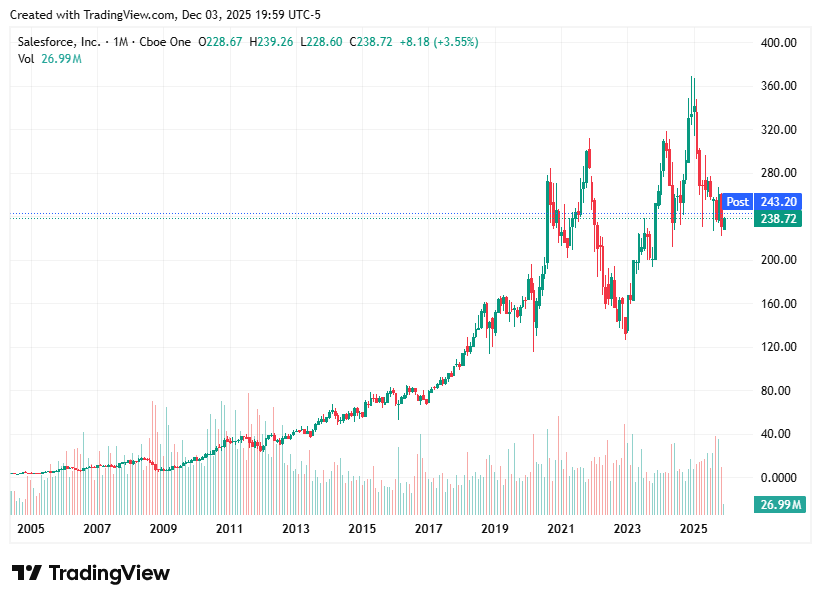
Salesforce (CRM) Delivers: In a much-needed dose of good news for the software sector, Salesforce reported earnings that beat Wall Street expectations. They posted adjusted earnings per share of $3.25 (vs. $2.86 expected) on revenue that was essentially in line. More importantly, their forward guidance was strong, signaling that demand for their enterprise software remains robust despite the uncertain economic backdrop. The stock popped 2% in after-hours trading. This is a testament to the “stickiness” of their platform; once a company is integrated into the Salesforce ecosystem, it’s very difficult and costly to leave. It shows that large enterprises are still willing to spend on mission-critical software, a positive sign for other enterprise software giants like Microsoft (MSFT) and Oracle (ORCL).
Delta (DAL) Hits Turbulence: Delta Air Lines warned that the ongoing government shutdown will result in a $200 million hit to profits. This is a direct consequence of political dysfunction impacting corporate America. The shutdown affects air travel in multiple ways: it reduces travel by government employees, slows down TSA and air traffic control operations, and creates general economic uncertainty that dampens leisure and business travel demand. This warning is a negative read-through for the entire airline industry, including competitors like United Airlines (UAL) and American Airlines (AAL).
Tech Talent Wars: Meta Poaches from Apple: In a significant move, Meta (META) has hired Apple’s head of UI (User Interface) design. This is a major talent acquisition and signals Meta’s aggressive push to refine the user experience on its platforms, likely for its metaverse ambitions and to make its existing apps more engaging. For Apple (AAPL), this is a notable loss. The company’s intuitive and clean UI has always been a key differentiator. Losing the leader of that team to a direct competitor is a blow. This also comes as Meta announced it will begin removing users under 16 from its platforms in Australia, a proactive move to get ahead of regulatory pressure that could impact its user growth numbers in the region.
Insider Confidence at Blue Owl (OWL): Following a recent sell-off in the stock, executives and staff at alternative asset manager Blue Owl purchased a massive $200 million worth of their own company’s shares. This is the ultimate “put your money where your mouth is” signal. When insiders buy their own stock in such large quantities, it signals a profound belief that the market is undervaluing the company and that its long-term prospects are bright. For investors looking for beaten-down names in the financial sector, this is a huge vote of confidence that is hard to ignore.
Commodity Crunch: Glencore (GLNCY) Cuts Jobs: Mining and commodities giant Glencore announced plans to cut 1,000 jobs as part of a cost-cutting drive. This reflects the challenging environment in the commodities sector, where prices have been volatile and global demand is softening, particularly with weakness in China’s economy. This is a bearish signal for the global industrial economy.
This market is a complex tapestry woven from economic data, political maneuvering, and corporate strategy. The biggest takeaway from the past 24 hours is that the ground is shifting beneath our feet. The AI boom faces a sobering economic reality, the labor market is showing definitive cracks, and corporations are making bold, sometimes shocking, decisions in response to a rapidly changing social and political landscape.
As investors, we must remain vigilant, adaptable, and focused on quality. The easy money has been made. The next phase will reward patience, discipline, and a deep understanding of the crosscurrents shaping our world.
Disclaimer: The information contained in this newsletter is for informational purposes only. You should not construe any such information or other material as legal, tax, investment, financial, or other advice. Nothing contained in this newsletter constitutes a solicitation, recommendation, endorsement, or offer by Stock Region or any third-party service provider to buy or sell any securities or other financial instruments in this or in any other jurisdiction in which such solicitation or offer would be unlawful under the securities laws of such jurisdiction. All content in this newsletter is information of a general nature and does not address the circumstances of any particular individual or entity. The author may hold positions in the securities mentioned. Past performance is not indicative of future results.