

Records Fall, but What's Really Happening Under the Hood?
The stocks featured in this report were previously delivered in our trading room in real-time. To access Stock Region’s real-time trade ideas, then be sure to purchase a membership now.

Disclaimer: The following newsletter is for informational and entertainment purposes only. It is not financial advice. The content reflects the opinions of the author and Stock Region, and should not be considered a recommendation to buy or sell any securities. All investing involves risk, and you should conduct your own research and consult with a qualified financial advisor before making any investment decisions. We may hold positions in some of the stocks mentioned.
What a week it’s been. If you only glanced at the headlines, you’d think everything was coming up roses. The S&P 500, Nasdaq, and Dow all blazed new trails, hitting fresh all-time highs. It’s the kind of news that makes you want to pop the champagne and dream of early retirement. But as we always do here, we’re going to peel back the layers and look at what’s really driving this market. Because underneath that shiny, record-setting veneer, a more complicated and, frankly, more interesting story is unfolding.
The big dogs are pulling the wagon, no doubt about it. Mega-cap tech stocks put on a masterclass in market leadership. But while the giants feasted, the little guys got left behind. We saw significant weakness in small and mid-cap stocks, creating a divergence that should make any serious investor pause and think. Is this a sign of concentrated strength or a warning of underlying weakness?
In this edition, we’ll dissect the week’s action, from the mega-cap rally to the small-cap slump. We’ll celebrate the week’s biggest winners, from biotech breakouts to industrial powerhouses, and we’ll perform a post-mortem on the stocks that took a beating. We'll also unpack some major corporate news, including crucial FDA approvals for healthcare titans, a big bet from American Battery Technology, and a leadership shake-up at a regional bank.
So grab your coffee, settle in, and let’s make sense of it all.
Here’s what we’re covering today:
Market Overview: The Tale of Two Markets.
The Winners' Circle: Dissecting the Week's Biggest Gainers.
The Laggards' List: Understanding the Underperformers.
Corporate News & Catalysts: FDA Wins, Strategic Shifts, and More.
Growth Stocks to Watch: Our Picks for Your Radar.
Overall Market Forecast: Where Do We Go From Here?
Let’s get into it.
1. Market Overview: The Tale of Two Markets
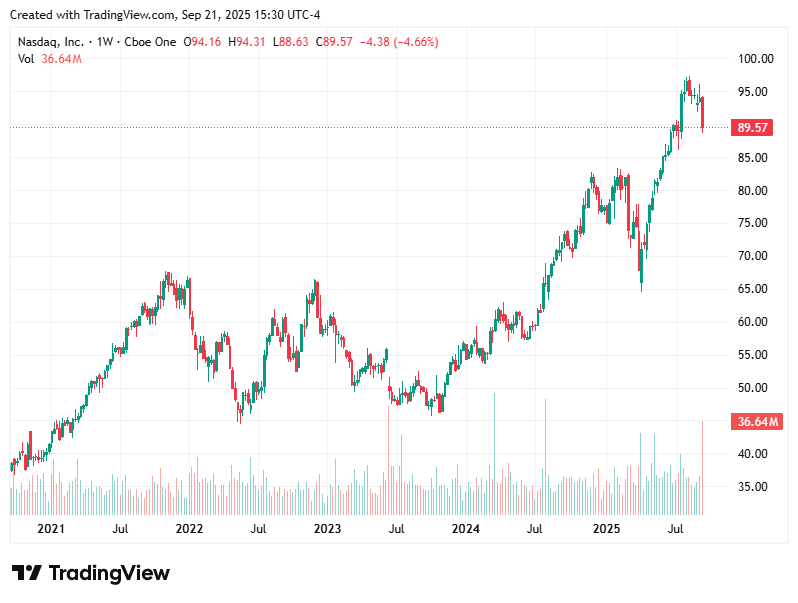
On Friday, the closing bell rang to the tune of victory for the S&P 500 (+0.5%), the Nasdaq Composite (+0.7%), and the Dow Jones Industrial Average (+0.4%). Each one notched a new intraday and closing record. It felt like a party, and the invitations seemingly went out only to the largest companies on the planet.
This wasn't a broad-based rally where a rising tide lifted all boats. This was a calculated, top-heavy surge powered by the behemoths we all know and watch. The Vanguard Mega Cap Growth ETF (MGK) climbed a healthy 0.8%, perfectly illustrating this trend. However, the S&P 500 Equal Weighted Index (RSP) was flat. When the equal-weighted version of an index underperforms its market-cap-weighted counterpart so dramatically, it’s a flashing neon sign that a handful of giants are doing all the heavy lifting. In fact, decliners on the NYSE and Nasdaq significantly outnumbered advancers.
This divergence was even more stark when looking at smaller companies. The Russell 2000, a benchmark for small-cap stocks, fell 0.8%. The S&P Mid Cap 400 also dropped by 0.8%. This is what I mean by a "Tale of Two Markets." While Wall Street celebrated new highs, Main Street’s smaller public companies were feeling the pain.
So, who were the heroes of the day? Unsurprisingly, Apple (AAPL) was a standout, surging 3.20% to close at $245.50. The catalyst was the launch of the new iPhone 17 lineup. Reports are flooding in about incredibly strong international demand, especially for the lower-cost model. It seems Apple’s magic touch is as potent as ever. They just know how to create a product cycle that investors can’t resist, and the market rewarded them handsomely.
Another familiar face, Oracle (ORCL), had a fascinating day. After an initial dip, the stock roared back to close up 4.11% at $308.81. The pivot came after reports of a "productive" call between the U.S. and Chinese presidents regarding TikTok. While a deal isn't finalized, the positive tone was enough to send shares of Oracle, a key player in the proposed U.S. operations of the social media giant, soaring. This is a perfect example of how geopolitical headlines can whip a stock around in a single session.
Other mega-caps like Alphabet (GOOG), up 1.15%, and Tesla (TSLA), up 2.21%, also played their part in propping up the major indices.
On the economic front, the market is still basking in the glow of anticipated rate cuts. After the September FOMC meeting, Fed officials are now free to speak their minds. Fed Governor Stephan Miran stated he supports five rate cuts this year, a very dovish stance. Meanwhile, Minneapolis Fed President Neel Kashkari suggested two more cuts in 2025. This continuous chatter about easier monetary policy is like a steady tailwind for equities, especially for the growth-oriented tech giants whose valuations benefit from lower discount rates.
However, the bond market is telling a slightly different story. U.S. Treasuries sold off, with the 10-year note yield rising four basis points to 4.14%. Higher yields can sometimes be a headwind for stocks, so the fact that equities shrugged this off shows just how powerful the mega-cap momentum and rate-cut narrative are right now.
In summary, the week ended with a celebration, but it was a private party for the market’s biggest players. The underlying breadth was weak, and smaller companies were left out in the cold. This is a dynamic we need to watch closely. A healthy market sees broad participation. What we have right now is concentrated, powerful, but ultimately narrow strength.
2. The Winners' Circle: Dissecting the Week's Biggest Gainers
Every week, a new group of stocks captures the market's imagination, delivering spectacular returns. Understanding why these stocks soared is crucial. It helps us identify trends, spot opportunities, and learn valuable lessons about market dynamics. Let's break down this week's champions.
Healthcare's High-Flyers
Healthcare was on fire this week, with these biotech names posting incredible gains.
Intellia Therapeutics (NTLA): The star of the show, rocketing up an astonishing 36.78% to close at $15.62. Intellia is a leader in CRISPR gene-editing technology. This kind of explosive move in a biotech stock often points to positive clinical trial data, a new partnership, or a significant breakthrough. For Intellia, the excitement is building around its pipeline of in-vivo (inside the body) and ex-vivo (outside the body) therapies. A move this large suggests that big money is making a bet that their technology is on the cusp of major validation. Gene editing is one of the most exciting—and volatile—frontiers in medicine. A win for Intellia could have massive ripple effects across the entire sector. Investors who can stomach the risk are clearly seeing a huge potential reward.
Coherus BioSciences (CHRS): Another big winner, jumping 24.03% to $1.60. Coherus specializes in biosimilars and developing its own immuno-oncology therapies. Their strategy is a mix of creating lower-cost versions of expensive blockbuster drugs and swinging for the fences with novel treatments. This week’s surge could be related to positive developments with their biosimilar for Lucentis, an eye disease drug, or perhaps growing optimism about their PD-1 inhibitor, toripalimab. For a small-cap biotech like CHRS, every piece of good news can act as rocket fuel.
Cerus Corporation (CERS): Rounding out the healthcare winners, CERS climbed 19.51% to $1.47. Cerus focuses on blood safety, with its INTERCEPT Blood System designed to protect against a wide range of pathogens. Demand for blood safety is non-negotiable and evergreen. This week's gain might be tied to a new government contract, expanded approval in a new region, or data showing the effectiveness of their system against an emerging threat. It’s a less glamorous side of healthcare than gene editing, but no less critical, and the market clearly recognized some new value in their offering this week.
Industrials: Power and Progress
The industrial sector saw some of its members post impressive gains, driven by themes of clean energy and the gig economy.
Ballard Power Systems (BLDP): Leading the charge with a 32.37% gain to $2.74. Ballard is a pioneer in hydrogen fuel cell technology. This is a notoriously volatile space, heavily influenced by government policy and energy prices. A spike like this suggests a significant catalyst. It could be a new, large-scale order for their fuel cell stacks, a favorable policy announcement promoting hydrogen energy, or a partnership with a major automotive or industrial company. With the global push for decarbonization, companies like Ballard are at the center of a massive potential transition, and this week, investors bet heavily that the transition is accelerating.
Bloom Energy (BE): Another clean energy player that had a fantastic week, rising 26.46% to $85.06. Bloom Energy provides solid oxide fuel cells for on-site power generation. Their "Bloom Box" is used by large data centers, hospitals, and retailers to ensure reliable, clean power. The drivers here are similar to Ballard's: the push for green energy and energy independence. A major new customer announcement or an upgrade from Wall Street analysts could easily have sparked this rally. Bloom's story is particularly appealing as it addresses both environmental concerns and the practical need for uninterrupted power in our digital world.
Upwork (UPWK): Shifting gears from energy to labor, Upwork jumped 19.28% to $20.11. Upwork is a leading platform connecting freelancers with businesses. The "future of work" is a powerful narrative, and Upwork is at its core. This gain could be a reaction to strong user growth metrics, a positive outlook on corporate spending on freelance talent, or perhaps an M&A rumor. As companies increasingly look for flexible talent solutions, platforms like Upwork are poised to benefit. This week's pop shows that investors are renewing their faith in the gig economy's growth trajectory.
Consumer Discretionary: Bots, EVs, and Eyewear
This sector is all about what we choose to buy with our extra cash, and this week, investors were betting on some interesting consumer trends.
iRobot (IRBT): The maker of the Roomba vacuum cleaner surged 25.15% to $4.28. This stock has been through the wringer, especially after its planned acquisition by Amazon fell through. A jump of this magnitude in a single week is significant. It could be driven by a few things: severe short covering (investors who bet against the stock being forced to buy back shares), rumors of a new acquisition offer from a different suitor, or perhaps a fundamental belief that the company, now independent again, can turn its fortunes around. It’s a high-risk, high-reward play, and this week, the bulls won a major battle.
NIO Inc. (NIO): The Chinese electric vehicle maker accelerated 18.01% to $7.34. NIO is one of the most-watched EV stocks in the world, and its performance is often seen as a barometer for the Chinese consumer and the broader EV market. This week’s strong performance could be linked to positive delivery numbers, a new model announcement, or favorable government incentives in China. Despite intense competition, NIO has a loyal following and a strong brand, particularly with its innovative battery-swapping technology. Investors seem to be betting that NIO can successfully navigate the crowded field.
National Vision Holdings (EYE): This one might surprise you. A retail eyewear company jumping 17.14% to $26.93. National Vision operates chains like America's Best and Eyeglass World, targeting the budget-conscious consumer. A move like this could be triggered by an analyst upgrade citing strong store traffic, better-than-expected margins, or an optimistic forecast for consumer spending on healthcare necessities like vision care. It’s a reminder that strong gains aren't always found in high-tech stocks; solid, well-run retail can also deliver impressive results.
Information Technology: Chips and Solar Strength
Tech, the market's darling, had its own set of superstars beyond the mega-caps.
Intel (INTC): The semiconductor giant had a phenomenal week, rising 22.86% to $29.59. For years, Intel was seen as a legacy player losing ground to competitors like AMD and NVIDIA. This powerful rally signals a potential sea change in perception. It could be driven by optimism around their new chip architectures, progress in their foundry business (manufacturing chips for other companies), or a belief that the stock has simply gotten too cheap compared to its peers. A resurgent Intel would be a massive story for the entire tech landscape. This move feels like institutional money deciding that the turnaround story is real.
SolarEdge Technologies (SEDG): A key player in the solar energy space, SEDG climbed 22.39% to $35.46. SolarEdge provides inverters and power optimizers, the "brains" behind a solar panel system. The solar sector has been beaten down due to high interest rates (which make financing solar projects more expensive) and inventory issues. This week's rebound is a breath of fresh air. It could be a sign that inventory levels are normalizing, demand from Europe is picking up, or that the worst is finally over for the industry. Like the hydrogen stocks, SEDG is a bet on the green energy transition, and this week, that bet paid off handsomely.
3. The Laggards' List: Understanding the Underperformers
For every winner, there’s a loser. Examining the stocks that fell the hardest can be just as instructive as studying the ones that soared. It can reveal sector-wide headwinds, company-specific problems, or shifts in investor sentiment. Let's dig into this week's notable decliners.
Consumer Staples & Financials: A Shocking Plunge
Hain Celestial Group (HAIN): The biggest loser on our list, HAIN plummeted 29.53% to close at a gut-wrenching $1.52. Hain Celestial is in the natural and organic products space, a category that should theoretically be resilient. A drop of this magnitude is catastrophic and rarely happens without a specific, company-destroying piece of news. This could be a disastrous earnings report with a shocking guidance cut, the loss of a major distribution partner (like a key supermarket chain), or perhaps an accounting issue or regulatory investigation. For a company in a defensive sector like consumer staples to fall this hard suggests a deep, fundamental problem has been uncovered. Investors who held this stock through the week experienced immense pain.
FactSet Research Systems (FDS): Another stunning decline, this time in the financials sector. FDS dropped 20.03% to $289.37. FactSet provides financial data and analytics to investment professionals. It's a high-quality, sticky business. For it to lose a fifth of its value in a week is highly unusual. The most likely culprit is a very disappointing earnings report, specifically a significant slowdown in its Annual Subscription Value (ASV) growth, which is a key metric for the company. A slowdown here would suggest that its clients (investment banks, asset managers) are cutting back on spending, which is a worrying sign for the broader financial industry. This is a bellwether stock, and its fall should not be ignored.
Healthcare: Trial Troubles and Fading Hopes
While some biotechs soared, others crashed and burned. This is the brutal reality of the sector.
Abeona Therapeutics (ABEO): This gene therapy company fell 16.56% to $5.37. Abeona is focused on rare diseases, a field where the potential rewards are immense but the risks are equally high. A drop like this is often tied to clinical trial news. It could be a setback in a key program, a request from the FDA for more data (which means delays and more cash burn), or less-than-stellar results that fail to meet high expectations. For small biotechs, the pipeline is everything, and any perceived weakness can send the stock tumbling.
uniQure N.V. (QURE): Another gene therapy name that took a hit, QURE dropped 15.89% to $13.87. uniQure is notable for having the first approved gene therapy for hemophilia B, Hemgenix. The post-approval journey can be just as challenging as the pre-approval one. The stock's decline could be related to a slower-than-expected commercial launch, reimbursement challenges with insurers, or perhaps competitive concerns. Sometimes the market's sales expectations for a new breakthrough drug are simply too optimistic, and the stock corrects when reality sets in.
Consumer Discretionary: Dining, DIY, and Downbeat Outlooks
The consumer discretionary sector, which is highly sensitive to the economic outlook, saw some significant pain this week.
Dave & Buster's (PLAY): The "eat, drink, play" entertainment venue saw its stock get played, falling 17.03% to $19.62. This kind of decline is almost certainly linked to a poor earnings report. The key metrics to watch for a company like PLAY are same-store sales and customer traffic. A miss on these, coupled with a weak forecast, would signal to investors that consumers are pulling back on discretionary entertainment spending. This is a canary in the coal mine for the health of the consumer.
Cracker Barrel Old Country Store (CBRL): The roadside dining staple crumbled, falling 15.03% to $43.48. Similar to Dave & Buster's, Cracker Barrel's performance is a direct reflection of consumer behavior. A weak earnings report, citing lower traffic and perhaps higher food or labor costs squeezing margins, would be the likely cause. The company has also been undergoing a strategic transformation, and if investors are losing faith that the plan will work, they will head for the exits.
Darden Restaurants (DRI): The parent company of Olive Garden and LongHorn Steakhouse, DRI slid 13.16% to $184.64. Seeing a blue-chip restaurant operator like Darden fall this much is significant. Even if their earnings were okay, a weak guidance for the coming quarters would be enough to spook the market. If Darden, with its scale and brand power, is warning of a slowdown, it sends a negative signal across the entire casual dining industry. Investors are likely worried that persistent inflation is finally causing diners to trade down or eat at home more often.
Industrials: Building & Construction Blues
The housing and construction-related names had a rough week, indicating worries about a potential slowdown in the sector.
Builders FirstSource (BLDR): A major supplier of building materials, BLDR dropped 13.13% to $123.99. This stock is highly correlated with the health of the U.S. housing market. The decline comes despite some recent strength in housing data. This could be a case of "sell the news" or perhaps a warning from the company about future demand. A key earnings report from homebuilder Lennar (LEN), which missed on revenue, certainly didn't help sentiment. The entire home construction ecosystem felt the aftershocks from that report, and BLDR was a major casualty.
Trex Company (TREX): The maker of composite decking and railing fell 12.16% to $53.10. Trex is a leader in its category and a popular name for investors betting on the home renovation trend. A decline of this size suggests that the renovation boom might be cooling off. High interest rates make home equity loans more expensive, and consumers might be tightening their belts on big-ticket projects like a new deck. An analyst downgrade or cautious commentary from the company could have easily triggered this sell-off.
This week’s losers list paints a picture of concern. We see signs of consumer pullback (PLAY, CBRL, DRI), worries about the housing and renovation market (BLDR, TREX), and brutal, company-specific execution issues (HAIN, FDS). It’s a valuable counterpoint to the mega-cap rally and a reminder to always look at the full picture.
4. Corporate News & Catalysts: The Stories Moving Stocks
Beyond the broad market trends, individual company news provides the catalysts that can create or destroy billions in value overnight. This week was packed with significant developments.
Pharma Giants Score Major FDA Approvals
The FDA was busy this week, handing out two significant approvals to a couple of the biggest names in healthcare. This is where pipelines turn into profits.
Merck & Co. (MRK): FDA Approves Subcutaneous KEYTRUDA
This is a huge deal. Merck (MRK) received approval for KEYTRUDA QLEX, a subcutaneous (under the skin) version of its blockbuster cancer drug, KEYTRUDA. The stock barely moved on the news, closing at $81.50, but don't let that fool you. KEYTRUDA is one of the best-selling drugs in the world, administered via intravenous (IV) infusion in a hospital or clinic. This new subcutaneous version can be given by a healthcare provider in as little as one minute.
Our Take: This is a game-changer for both patients and Merck. For patients, it means less time in the clinic and a more convenient treatment experience. For Merck, it's a brilliant life-cycle management strategy. As the original KEYTRUDA patent expiration date inches closer, developing new formulations like this helps to extend the franchise's dominance and protect it from biosimilar competition. It creates a new moat around their most important asset. The market may have yawned because this was largely expected, but the long-term financial implications are enormous. It solidifies KEYTRUDA's position for years to come.Johnson & Johnson (JNJ): FDA Approves Subcutaneous TREMFYA
In a similar vein, Johnson & Johnson (JNJ) got a win for its immunology drug, TREMFYA. It was approved as a fully subcutaneous regimen for adults with ulcerative colitis. The stock reacted positively, closing up at $176.20. Previously, TREMFYA had a subcutaneous option for Crohn's disease, but this expands its reach and convenience. Patients can now self-administer the drug from the very start of their treatment.
Our Take: Convenience is a powerful driver in modern medicine. Like Merck's news, this approval makes a successful drug even more appealing. It improves the patient experience and gives JNJ a competitive edge against other treatments for ulcerative colitis that may require clinic visits. For a giant like JNJ, growth comes from expanding the labels of its existing blockbusters and making them easier to use. This is a solid, incremental win that will contribute meaningfully to the bottom line. It's a reminder that innovation isn't just about discovering new molecules; it's also about improving the delivery and accessibility of existing ones.
Strategic Moves and Financial Filings
Companies were also busy shoring up their finances and adjusting their strategies.
American Battery Technology Co. (ABAT): Files for $250 Million Shelf Offering
ABAT, a company focused on battery recycling and materials, filed for a $250 million mixed securities shelf offering. The stock reacted well, closing up at $3.30. A shelf offering allows a company to issue securities (like stock or debt) over a period of time without having to file separate paperwork for each issuance.
Our Take: This is a forward-thinking move. For a company in a capital-intensive industry like battery technology, having access to capital is critical. They need money to build facilities, fund R&D, and scale up operations. By filing a shelf offering now, when the stock has some momentum, they are preparing for the future. It gives them the flexibility to raise cash quickly when market conditions are favorable or when a strategic opportunity arises. While the potential for future dilution can sometimes spook investors, in this case, the market seems to be viewing it as a sign of ambition and preparation for growth. They are loading the war chest.Genfit (GNFT): Discontinues a Key Program
This is the kind of news that biotech investors dread. Genfit (GNFT) announced it is discontinuing its VS-01 program for Acute-on-Chronic Liver Failure (ACLF) after a serious adverse event (a case of peritonitis) was reported in a clinical trial. The stock was relatively stable, closing at $4.33, which suggests the market may have already priced in a high risk of failure for this program. The company will now reprioritize the development of VS-01 for a different condition, Urea Cycle Disorder (UCD).
Our Take: This is a tough but necessary decision. Patient safety is paramount. While discontinuing a trial is always disappointing, it's better to cut your losses early than to pour more money into a program with a questionable risk/benefit profile. The key here is the pivot to UCD. The company believes the drug still has potential in a different application. The market's muted reaction indicates that investors are willing to give them the benefit of the doubt for now. However, management's credibility is on the line. They need to execute flawlessly on the new prioritized program to regain investor confidence. This is a crucial turning point for Genfit.Visa (V): $500 Million Litigation Deposit
Visa (V) disclosed it authorized a $500 million deposit into its U.S. litigation escrow account. The stock took the news in stride, climbing to $341.61. This account is used to handle settlements and judgments from various legal battles, most notably the long-running antitrust cases related to interchange fees.
Our Take: This is just the cost of doing business for a financial titan like Visa. A $500 million deposit, while a huge number for most companies, is a rounding error for a cash-generating machine like Visa. The market's positive reaction shows that investors see this as a responsible move to provision for known legal risks. It removes a small piece of uncertainty. It's far better to see a company proactively funding its escrow account than to be surprised by a massive, unfunded legal judgment down the road. This is a sign of prudent financial management, not weakness.
5. Growth Stocks to Watch: Picks For Your Radar
Based on the week's news and underlying trends, here are a few stocks I'm adding to our personal watchlist. These aren't buy recommendations, but they represent compelling stories that I believe warrant closer attention.
Intel (INTC): The Sleeping Giant Awakens?
The Story: After a monster 22.86% gain this week, the question is: is this the start of a real turnaround or just a head fake? For years, Intel has been criticized for falling behind rivals in chip design and manufacturing. But under CEO Pat Gelsinger, the company is investing heavily in a multi-year plan to regain its technological leadership. This includes an aggressive roadmap of new process technologies and building out its foundry business to compete with TSMC.
Why I'm Watching: The stock is still cheap compared to its peers. If their foundry services gain traction and their next-gen chips (like their upcoming Arrow Lake and Lunar Lake processors) deliver on their performance promises, the earnings potential is massive. The market is starting to believe. This week's move felt like institutional capital finally rotating into the name. I'm watching for execution. Can they hit their aggressive roadmap deadlines? Can they sign a major new foundry customer? If they can, this stock could still have a long way to run. It's a bet on one of the greatest comebacks in American corporate history.
Ballard Power Systems (BLDP): A Pure Play on the Hydrogen Economy
The Story: Ballard surged over 32% this week, putting the spotlight back on the hydrogen fuel cell space. Hydrogen offers a path to decarbonize heavy-duty transport (trucks, buses, trains, ships) and industrial applications where batteries aren't practical. Ballard is a technology leader in this field with decades of experience.
Why I'm Watching: The hydrogen theme is real, but it's been plagued by false starts. This time feels different. With massive government incentives from the Inflation Reduction Act in the U.S. and similar programs in Europe, the economic viability of hydrogen is improving. I'm watching for concrete orders. A big order for hundreds of fuel cell modules for a fleet of city buses or a partnership with a major truck manufacturer would be a huge validation. The stock is volatile, but the potential addressable market is colossal. If the hydrogen economy truly takes off, Ballard is positioned to be a primary beneficiary.
Coherus BioSciences (CHRS): A Two-Pronged Growth Strategy
The Story: Coherus jumped 24% this week. The company operates a fascinating dual strategy. First, they develop biosimilars—lower-cost versions of expensive biologic drugs—which generate near-term revenue. They use the cash flow from this stable business to fund their second strategy: developing their own novel immuno-oncology drugs, like their PD-1 inhibitor toripalimab.
Why I'm Watching: I love this model. It balances the steady, predictable revenue of biosimilars with the high-risk, high-reward potential of novel drug development. It's a smarter way to build a biotech company. I'm watching for two things: First, the sales ramp of their biosimilar products, especially their version of Humira. Second, any clinical or regulatory progress with toripalimab. If they can get their own cancer drug approved, it would completely transform the company's valuation. This week's move suggests optimism is building on one or both of these fronts.
Lennar (LEN): A Contrarian Look at Housing
The Story: Lennar got beaten down this week, falling over 4% after a revenue miss. Sentiment in the housing sector is shaky due to high interest rates. So why is it on our watchlist? Because Lennar is one of the best-run homebuilders in the country.
Why I'm Watching: There is a chronic undersupply of housing in the United States. Millennials are in their prime home-buying years. While high mortgage rates are a major headwind, homebuilders like Lennar can counteract this by offering mortgage rate buydowns and other incentives. Lennar's management is savvy, and they know how to navigate cycles. The stock's pullback could present a long-term opportunity for patient investors who believe in the structural demand for housing. I'm watching mortgage rate trends and Lennar's upcoming reports on new orders and margins. If they can demonstrate resilience in this tough environment, it will be a sign of immense strength. Buying best-in-class companies when their sector is out of favor can be a very profitable long-term strategy.
6. Overall Market Forecast: Where Do We Go From Here?
Peering into the future is a humble exercise at best, but by synthesizing the data, trends, and sentiment, we can form a rational outlook.
The Short-Term View (Next 1-3 Months): A Cautious Consolidation
I believe the market is due for a pause or a slight pullback. The divergence between the mega-caps and the rest of the market is unsustainable. Rallies built on such narrow leadership often end in one of two ways: either the rest of the market catches up (a broadening of the rally), or the leaders fall back to meet the laggards (a correction).
Given the weakness we saw in the Russell 2000, the transportation sector, and consumer-facing stocks like restaurants and retail, I lean towards the latter. The market has priced in a lot of good news, particularly around future Fed rate cuts. Any economic data that comes in hotter than expected, pushing back that rate-cut timeline, could serve as a catalyst for a sell-off.
The major indices may chop around their new highs, but I expect volatility to pick up. The risk/reward of chasing the high-flying mega-caps right now feels skewed to the downside. I wouldn't be surprised to see a 5-7% correction in the S&P 500 sometime this fall as the market digests its recent gains and re-evaluates the economic landscape. This would be a healthy development, shaking out some of the froth and creating better entry points for long-term investors.
The Long-Term View (6-12 Months and Beyond): Constructively Bullish
Looking further out, the outlook becomes more positive. The primary driver remains the Federal Reserve. As they eventually do begin to cut rates in 2025, it will provide a significant tailwind for the economy and the stock market. Lower borrowing costs will stimulate business investment and ease the pressure on consumers.
The technological themes driving this market are powerful and long-lasting. Artificial Intelligence, the green energy transition, and advancements in biotechnology (like the gene-editing work of NTLA) are not fads; they are multi-decade transformations that will create enormous wealth. Companies that are true leaders in these fields will continue to reward shareholders.
Corporate balance sheets are generally healthy, and profitability remains strong. While a short-term economic slowdown is possible, I don't see the makings of a deep or prolonged recession. The labor market is still robust, and consumer balance sheets, while showing some signs of strain at the lower end, are holding up.
Our strategy would be to use any near-term weakness or consolidation to build positions in high-quality companies that are poised to benefit from these long-term trends. This includes:
Profitable Tech Leaders: Companies with strong moats and clear leadership in areas like AI, cloud computing, and cybersecurity.
Select Industrials: Companies enabling the energy transition, automation, and the reshoring of manufacturing.
Healthcare Innovators: Businesses with approved breakthrough drugs or game-changing medical technologies that have a clear path to profitability.
Best-in-Class Consumer Names: Well-run companies that can thrive even in a slower economic environment.
The path forward may be bumpy in the short term. The market's internal health needs to improve. But the long-term picture, supported by eventual monetary easing and powerful secular growth trends, remains bright. Be patient, be selective, and be ready to take advantage of the opportunities that market volatility will inevitably provide.
Final Disclaimer: This newsletter expresses the opinions of Stock Region. We are not registered financial advisors. All information is provided for educational and entertainment purposes only. Investing in the stock market involves significant risk, including the potential loss of principal. You should always perform your own due diligence and consult with a professional financial advisor before making any investment decisions. Ticker symbols and statistics are provided for informational purposes and were believed to be accurate at the time of writing, but may contain errors.